23 December 2025
Role deep dive: Programme Facilitator
In this series, we look at some of the different roles available at Corrections, and help to break them down for jobseekers. This article focuses on programme facilitators, our kaimahi who run group sessions to help people understand their offending and develop strategies for change.
What is a programme facilitator?
The work our programme facilitators do is unique. While there are some similarities to roles like teaching or life coaching, they don’t quite capture the essence of the role.
Programme facilitators plan and run programmes that are designed to help participants lead an offence-free life. A typical day might look like:
- Working within the prison with people in custody, or at community sites with those on a community sentence or order.
- Running a range of programmes to help participants understand and address their offending.
- Writing up the progress of individuals in programmes.
- Liaising with other key staff to ensure their programmes are applying best practice from a psychological and cultural perspective.
“It’s an interesting question, how to define the programme facilitator role. I don't think we think of ourselves as life coaches or as a teacher. We facilitate conversations and we facilitate thoughts and ideas. So, we bring an idea to the table, and we allow the participants to explore that idea and come up with answers for themselves.” – Programme Facilitator
“In a programme, we cover a variety of therapeutic and learning approaches, depending on the programme. For example, a programme might start with whanaungatanga, which helps to build that rapport for our participants and our facilitators, developing those core protocols, guidelines, or mini rules within the space to make sure that we are all safe within our group sessions.
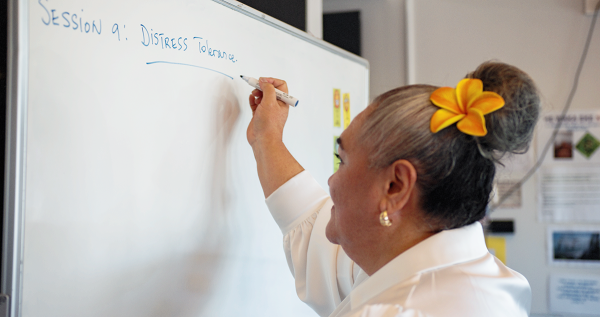
Then we might look at stressful situations, and strategies for distress tolerance. So, looking at the reason why they're here in the system for the first place and talking about discovering different thinking patterns. We may look into their relationship with others and whānau and the support people in someone’s life circle. We have drug and alcohol sessions that focus on how that may have contributed to the offence. And in the end, we develop a safety plan which incorporates all the skills and tools that they've picked up or learnt throughout the program, and that's what they're taking with them on their graduation day.” – Programme Facilitator
What makes a great one?
Our programme facilitators need to be patient, empathetic, self-aware, and grounded, with excellent communication skills and a desire to work with people to solve problems. Great listening skills are also key.
“I feel like I have always been an empathetic person, but I think that getting to know the men (on the programme) and hearing their unique stories creates more empathy for me anyway.” – Programme Facilitator
“A good facilitator is a person who has patience, the ability to listen and be compassionate. and who has the genuine desire to make a difference in someone's life.” – Programme Facilitator
Finding your way in group sessions
While there are certain traits that are important, facilitators can come from a range of backgrounds and are provided with extensive training to support them in the role.
This training, along with ongoing reflective practice through cultural and clinical supervision, helps facilitators to navigate the challenges of the role and find their way in group sessions.
“I guess one of the challenges is the impact of hearing people’s stories. One of the requirements in our role is to respond to those appropriately. But our training helps us to introspect enough to know how to handle it when that time comes.” – Programme Facilitator
“There's that emotional intelligence you build up, and there’s the strategies you learn along with the participants in the programme as well.” - Programme Facilitator
Graduations – a day of meaning for everyone
Once a programme is completed, graduations mark a day of celebration for participants. These are a significant day, not only for programme participants, but also for the facilitators, closing out the chapter of the programme before beginning a new one.
“Graduations are a day of celebrations, a day of achievement for all participants. There are refreshments and participants can invite their loved ones or support people to come along and celebrate their achievement, then we’ll given them the completion certificate along with a graduation process or farewell celebrations for them. That just says a lot about how the Department of Corrections cares for, not just for their staff, but for their people who come through the system and come through the department.
On graduation days, I remember the story of Sir Edmund Hillary when he reached the top of Mount Everest. And he said he looked around and he observed the wonders of the universe. And then he said, it wasn't the mountain that I conquer, but myself. And for a lot of our people who come through the programme, it's life changing, even if it’s just small gains in the right direction.” – Programme Facilitator
Ready to make a move?
Start your journey - check out the a list of our current opportunities then apply online today!